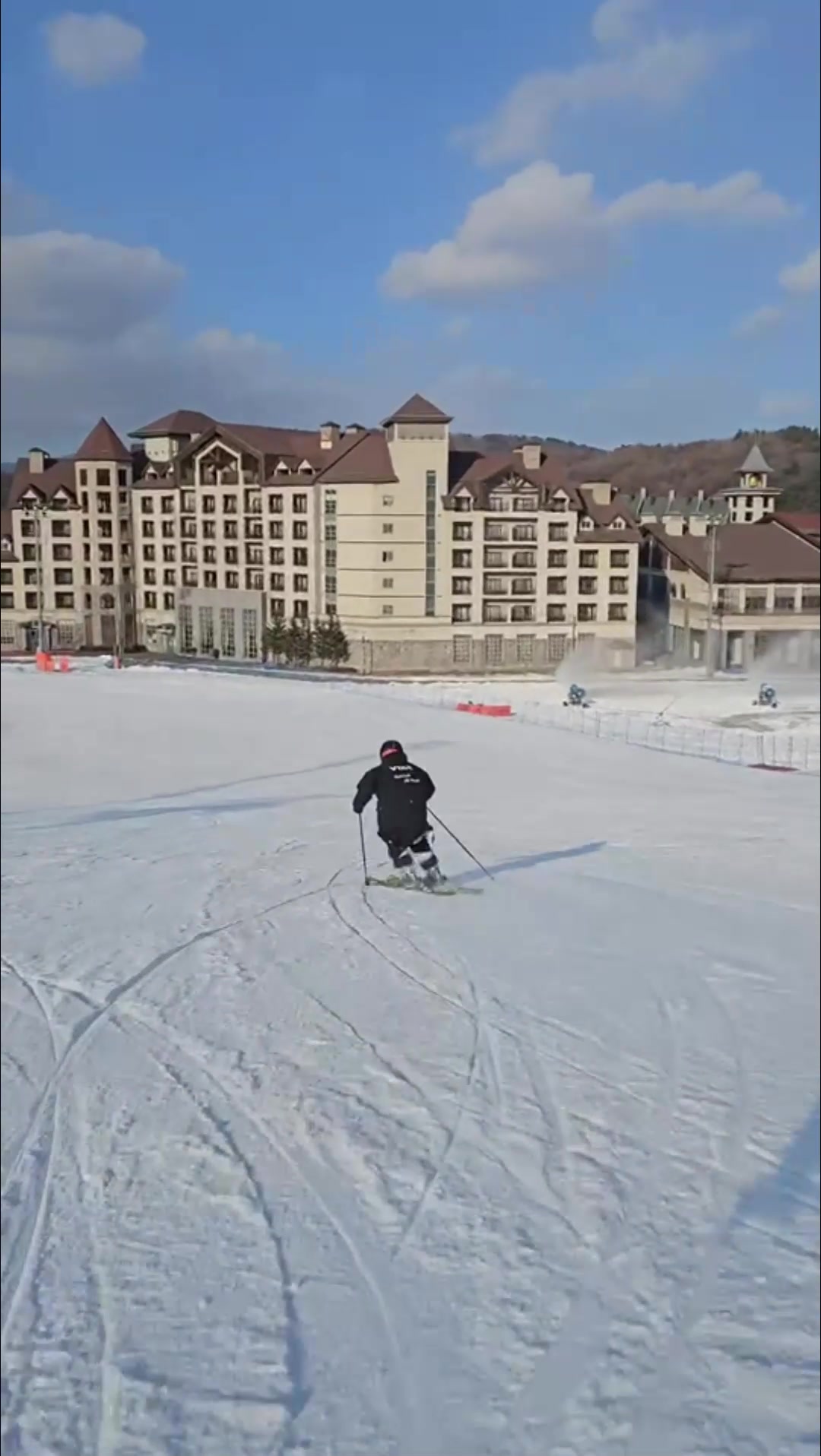
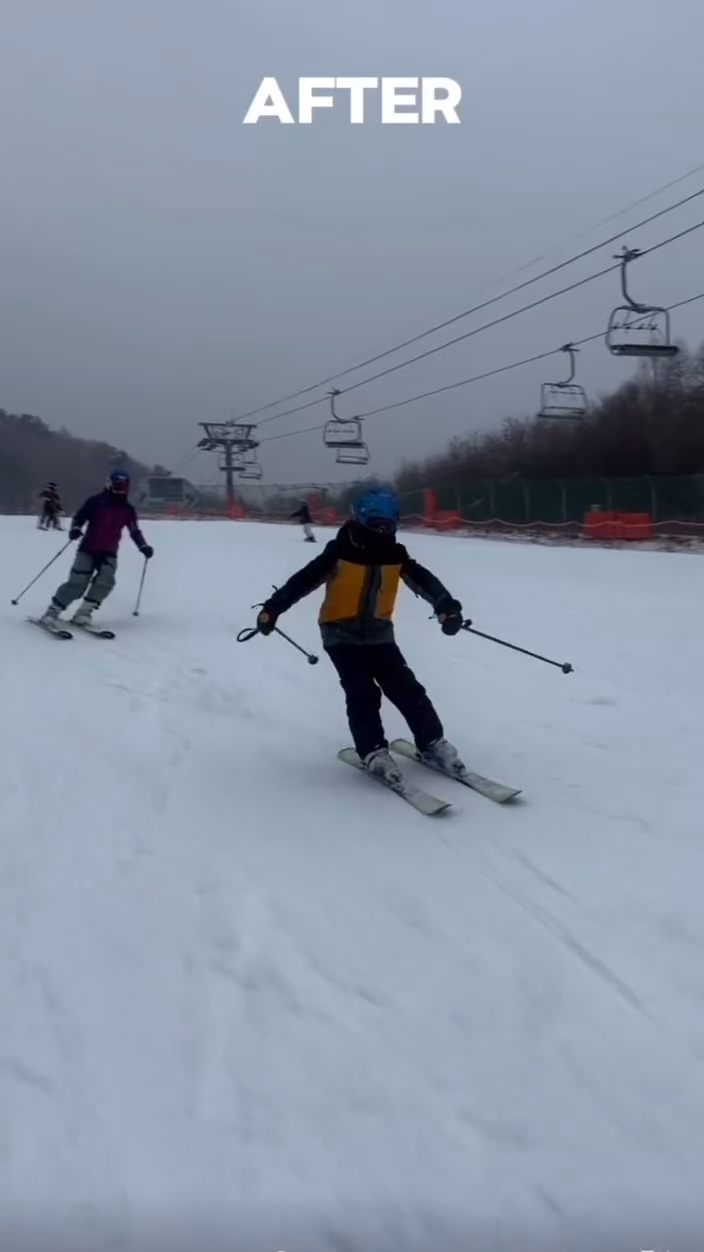
Four days can make a difference in skiing. The value is not simply four times as many runs. It is the continuity of observing a movement, making one focused adjustment, practising it, receiving feedback, and testing it again. This SKIDIEM Day 1 vs Day 4 video presents one skier’s training comparison; it is not a promise that every skier will achieve the same result on the same timetable.
What can you actually see in the video?
The video uses a split screen: “4 days with SKIDIEM” appears above and “1 day with SKIDIEM” below. In the Day 4 footage, the skier appears to use a greater edge angle, a lower and more organized body position, more parallel skis, and a comparatively consistent turn path. In the Day 1 footage, the stance is more upright, the edge angle is smaller, and ski spacing and direction vary more from turn to turn.
Those are visual observations, not laboratory measurements. Camera distance, light, clothing, slope, and snow conditions are not identical, and the video alone cannot prove that every visible difference was caused only by four days of coaching. The most responsible way to read it is as one skier shown at two training stages—not as a universal four-day result.
Why four connected training days are different
During a single lesson, a skier may understand a correction and reproduce it for one successful turn. That does not yet make the movement dependable. On the next day, a coach can check whether the change remained, appeared only after a verbal cue, or created a different compensation. This continuing feedback loop is what gives multi-day ski training in Korea its value.
- Day 1: establish a useful baseline for stance, pressure control, turn timing, and turn shape.
- Day 2: choose one priority and test a clear technical adjustment.
- Day 3: repeat the movement until “I did it once” starts becoming “I can do it more often.”
- Day 4: integrate separate exercises into linked turns and identify the next area for practice.
Effective coaching does not mean adding the maximum number of instructions. It means giving each run a clear job. Did the skier remain in an adaptable stance? Did the movement begin early enough? Did the turn develop smoothly? Could the skier repeat the adjustment without an immediate reminder?
Good skiing is not just about going faster
Good skiing is about controlling the skis, choosing a useful line, and moving efficiently enough to respond to terrain and snow conditions. When comparing Day 1 and Day 4, it is more useful to look for repeatable control than dramatic speed.
- Is the stance more centered while still allowing adjustment?
- Does each turn have a clearer beginning, development, and finish?
- Do edging and pressure changes become more progressive instead of arriving as a late reaction?
- Is there less unnecessary rotation through the shoulders and arms?
- Can the skier reproduce the change across several turns, rather than only once?
If you are preparing for your first time on snow, see our first ski lesson BEFORE→AFTER guide for balance, speed control, and basic linked turns. This article serves a different search intent: it focuses on how several connected coaching days can help organize and repeat a technique that the skier has begun to understand.
Who may benefit from multi-day ski coaching?
- Skiers who can descend independently but feel inconsistent from run to run
- Skiers who make a correction during a lesson but quickly return to an old habit
- Those who have reached a technical plateau and want clearer priorities
- Skiers working on stance, turn shape, timing, edging, or coordination
- Anyone who prefers a connected feedback process to isolated tips
A four-day format is not a universal prescription. The appropriate number of days, daily lesson time, terrain, and training focus should reflect the skier’s current ability, fitness, and goals. Learning speed also depends on practice quality, conditions, and how an individual responds to coaching.
Planning ski training in Korea with SKIDIEM
When contacting SKIDIEM, share your current ski level, previous lesson experience, preferred dates, group size, and the technique you most want to improve. If you prefer Alpensia, Yongpyong, or Vivaldi Park, include that in your inquiry. The available ski area, time, and programme should be confirmed for your dates; this article does not identify the video’s filming location as any particular resort.
Before booking, also confirm lesson duration, teaching language, lift access, equipment, insurance, transportation, and other inclusions. You can review the SKIDIEM lesson booking information and then tell the coaching team what you want your training days to accomplish.
Frequently asked questions
Does four days guarantee the same improvement shown in the video?
No. The clip presents one individual comparison. Starting level, learning speed, practice conditions, and outcomes vary.
Must all four training days be consecutive?
Continuity can support the feedback process, but the actual schedule and available format should be confirmed with SKIDIEM.
Is multi-day training only for advanced skiers?
Not necessarily. The right content depends on the skier’s current ability and goal, not simply on the number of days.
Give your next four days a clear technical goal
To explore ski training in Korea, tell SKIDIEM your level, dates, and the movement you want to improve. The team can confirm the available multi-day coaching options, location, and inclusions before you book.